
It’s Friday afternoon, less than a week until our long-awaited trip to Maui, Hawaii — and here I am with 14 open tabs, a dozen bookmarked videos, and still no actual plan. Between toddler chores, grad school coursework, and the daycare infection of the week, trip planning kept taking a backseat. Overwhelmed, staring blankly at my patio, I suddenly remember NotebookLM — that tool my batchmate used for her assignment last week. Could AI plan a trip better than a sleep-deprived mom with 14 tabs?
NotebookLM is an AI-powered research tool from Google that lets you pull together information scattered across formats — docs, YouTube videos, websites — and then acts as an expert on your sources: answering questions, generating summaries, building study guides, or just being a thinking partner. This might be my savior right now, I think to myself. Let’s see how well it actually does.
Once in NotebookLM, I create a new notebook and name it after the question haunting me all week: “Can AI plan a trip better than a sleep-deprived mom?”
One by one, I upload my sources — a guide to traveling with a toddler, beach recommendations, the Road to Hana post I’d been too scared to finish, places to eat, an article on Lahaina’s recovery after the fires. Ten sources in five minutes, while I sip my coffee.
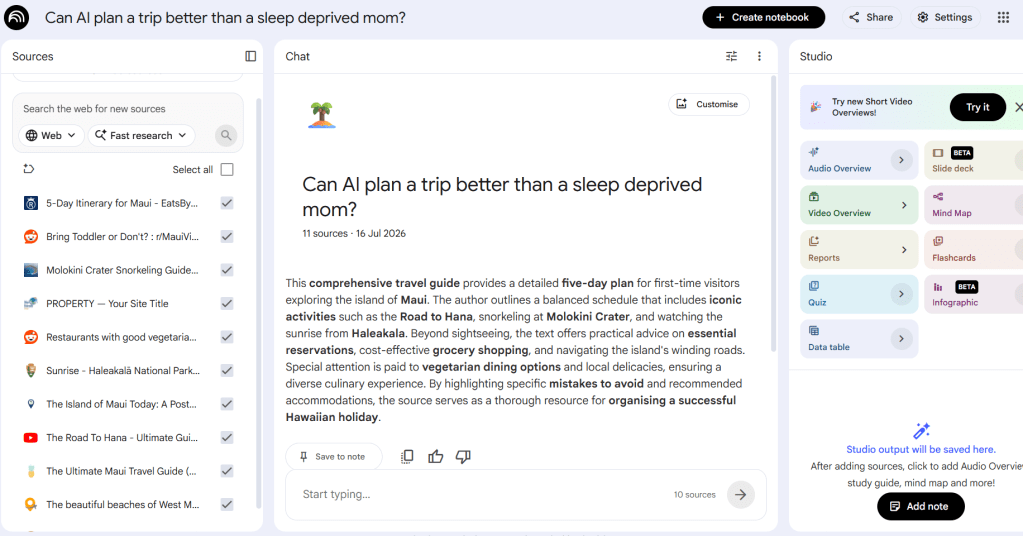
My first and most important ask: “Create an itinerary for a toddler and two adults staying in the resort area of Kaanapali.” The beauty of the tool lies in how much detail you give your prompts, so I make sure to give specific instructions — keep drive time to a minimum, maximize beach and pool time, and ensure indoor nap times in the afternoons to avoid the heat.
Less than 30 seconds later, a day-by-day plan appears, taking every one of my pointers into account. The level of detail is impressive — lunch and dinner suggestions, nap times built in, toddler-friendly activities recommended, and important tips included. Best part: you can quickly save it as a note, export it to a Google Doc, or copy it to your computer.
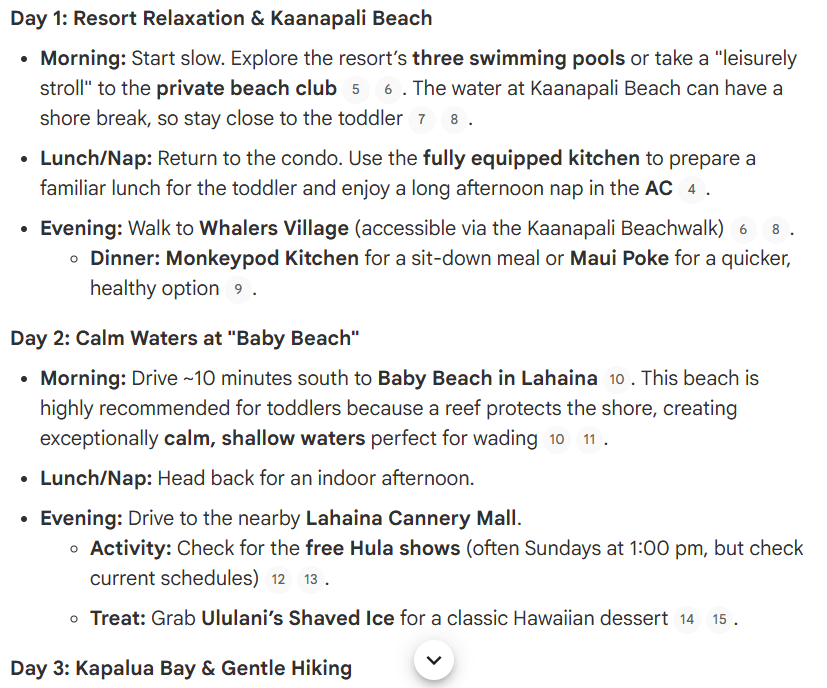
I play around a little — adding dietary preferences, nudging it to adjust the itinerary to be even more toddler-friendly — and every subsequent version comes back better and more customized. Happy mom.
Putting on my designer hat, I create mind maps, build comparison tables, and generate audio and video overviews — some really cool features to experiment with. My thinking partner hands me a beautifully laid-out beach comparison table, something that would have eaten up quite a lot of my mental bandwidth.
Look at this beautiful overview, I think to myself. It does need tweaking, but it’s not bad for a first draft, right?
Then I notice something. Why did it miss Road to Hana? That’s supposed to be the highlight of the trip. Oh — I see what happened. My prompt asked for the minimum drive time, so Road to Hana and the Haleakala sunrise are omitted entirely, and when I ask why, it gives me a detailed explanation for the omission, citing the comments and blog posts I’d uploaded about them not being kid-friendly. It doesn’t just search my sources; it weighs them against my constraints. I like how it picks up on the nuances. Impressive.
I push my luck and ask what the weather will be like during our trip. It politely reminds me that it gathers data only from the sources I’ve uploaded — and for every piece of information it generates, it cites exactly which source it came from. Fair enough. It’s a research assistant, not a crystal ball.
Overall, this is a fun exploration of a tool — and I can safely say that AI actually created a better itinerary than I would have and saved me many hours of work. It didn’t replace my judgment. It replaced my tabs.
Want to give this a try? Here’s a good tutorial about NotebookLM.
A friend of mine was once asked, “What will we do if AI does everything?” Her happy answer: “Meditate.” If tools like this keep saving us hours of laborious work, maybe we’ll finally have the time.
 apoorvasahasrabudhe